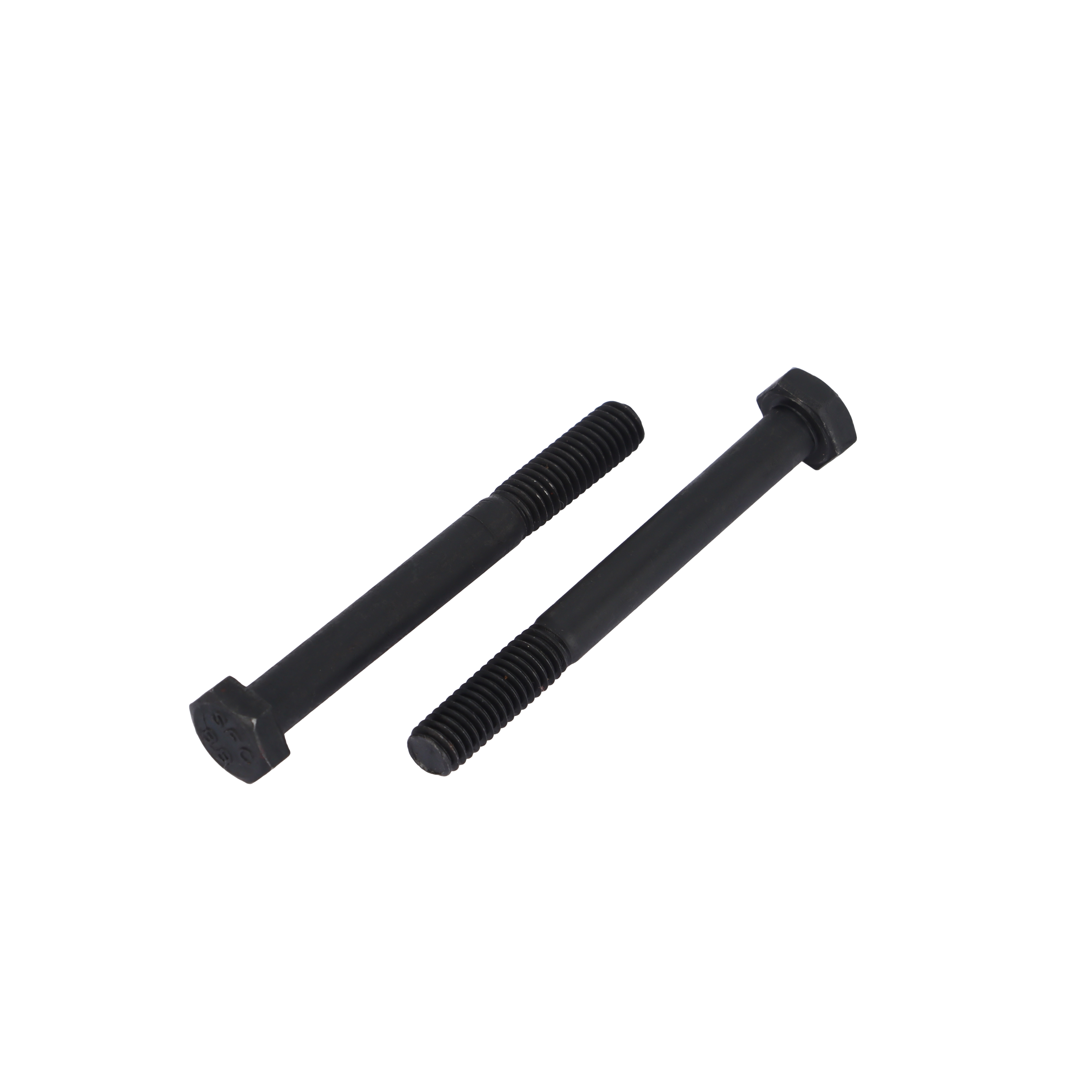
The designation "12.9" represents the pinnacle of commercial bolt strength grades, a classification defined by the international standard ISO 898-1. The number "12" denotes a minimum tensile strength of 12 x 100 = 1200 Megapascals (MPa), which is approximately 174,000 psi. The ".9" indicates a yield strength ratio of 90%, meaning the yield strength (the point at which the bolt begins to deform plastically) is 90% of the tensile strength, or roughly 1080 MPa. In practice, reputable manufacturers like BOBFAST engineer their bolts to exceed these minima, with typical 12.9 bolt tensile strength achieving at least 1220 MPa. Achieving this elite mechanical performance is a precise science. It begins with the selection of medium-carbon alloy steel, often containing chromium and molybdenum. This material is then subjected to a meticulously controlled heat-treatment process: quenching rapidly from a high austenitizing temperature to form a very hard, brittle martensitic structure, followed by tempering at a specific lower temperature. This tempering stage is crucial—it reduces brittleness and internal stresses while optimizing the balance between ultimate tensile strength, yield strength, and necessary ductility. Any deviation in this process can lead to insufficient strength or, conversely, excessive brittleness, making the bolt susceptible to sudden fracture under shock loads.
The extraordinary tensile strength of 1220 MPa makes grade 12.9 bolts indispensable in high-stress, high-reliability applications. In heavy machinery and industrial equipment, such as hydraulic presses, mining excavators, and injection molding machines, these bolts are used to assemble critical frames, cylinders, and platens that experience enormous cyclic loads. The automotive and motorsport industries rely on them for engine internals (like connecting rods), drivetrain components, and high-performance suspension systems, where their high clamp force prevents joint loosening under severe vibration. A particularly demanding application is in tooling, jigs, and fixtures, where 12.9 socket head cap screws provide immense clamping force in a compact form factor to secure mold plates and cutting dies. It is critical to note that with such high strength comes increased sensitivity to installation. Proper tightening using a calibrated torque wrench or, preferably, the turn-of-nut method or direct tension indicators is essential to develop the correct preload. Furthermore, due to the material's hardness, special attention must be paid to avoid hydrogen embrittlement, a risk introduced during certain plating processes. At BOBFAST, our professional R&D team focuses on mitigating these risks through optimized heat treatment and controlled plating post-treatments, ensuring our 12.9 bolts deliver their rated performance safely.
BOBFAST's manufacturing prowess, backed by over 50 R&D professionals and ISO 9001/IATF 16949 certifications, ensures every 12.9 bolt in our catalog embodies this rigorous science. We understand that engineers specify 12.9 for a reason: absolute confidence in performance. Therefore, we provide full material traceability and mechanical test reports. For projects requiring deviations from standard specifications—such as a need for specific corrosion protection that doesn't compromise strength, or a unique geometry for a proprietary machine—our capability in producing non-standard fasteners becomes a key asset. We invite you to contact our technical sales team to discuss how our certified 12.9 bolt tensile strength can be applied to your most challenging applications and to receive a detailed quotation tailored to your specific requirements.
 EN
EN